
A great day for a disaster…drill
By Kate Sheppard
The sun is shining, and there's no rain in sight. What a great day for a disaster drill! No? That's not what most people think when they greet the day with their morning coffee? Well here at Dines Point, that is exactly what we were thinking! After five community meetings and brainstorming sessions, we were eager to test our plan.
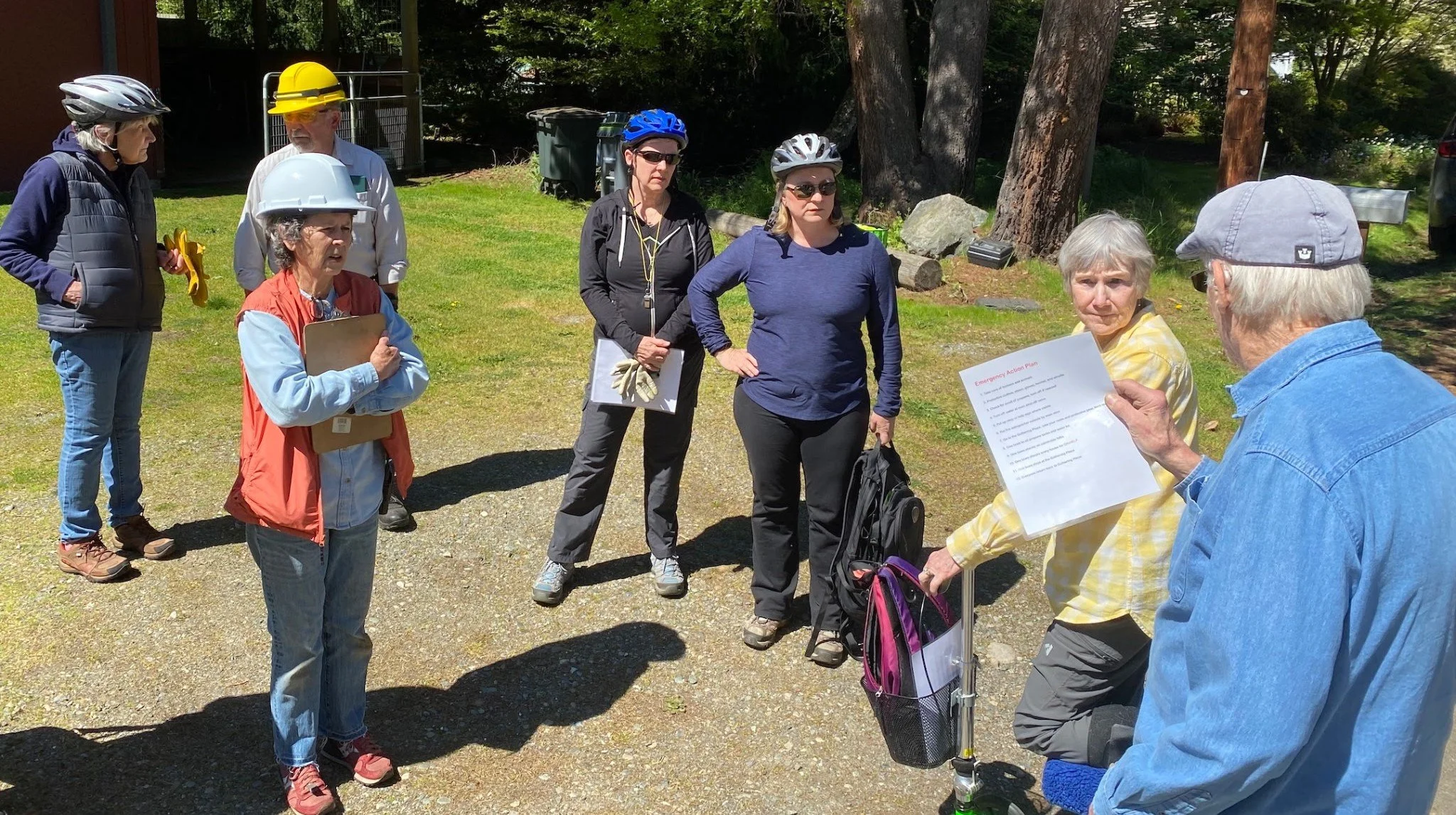
At exactly 1:00 in the afternoon, a neighborhood captain is out in the street texting everyone, saying, "Surprise, we are having an earthquake!" Everyone knows to put on long sleeve clothes, sturdy shoes, grab a hard hat, gloves and glasses, to check on everyone in the house, put up the OK sign, grab a fire extinguisher, head outside, check the propane tank for smells, shut off the water main, and go to the common meeting place. From start to finish, we figured that would take everyone 5 minutes tops. The neighborhood Captain happens to be on a knee scooter due to a foot injury; she navigates her way to the common meeting place, and waits. 1:05 pm, we should start seeing people any minute. 1:08 pm, what is happening, where is everyone? 1:10 pm.... something isn't right!
As we approached our neighbors almost a year ago to work together to prepare for a disaster, we heard quite a few discouraging comments. A few people said they were too busy, several shared that they didn't get along with all their neighbors, and three people explained that "it's been tried here and it didn't work then, so it won't work now." We felt like giving up on the idea, and then we asked ourselves how we could turn the project into something that people looked forward to instead of rolling their eyes in dismissal. We approached it like we would a party: several of us went knocking on doors, we had printed invitations, and we made sure people knew there would be food!
On our first pass through the neighborhood, about 40% of the neighbors said they would come to one meeting, which we scheduled for a Saturday in three weeks. We made another pass through the neighborhood and we did a lot of listening; a few more people said they would give it a try. What a surprise, we had 70% of the neighbors gathered together for our first meeting. There were some wonderful questions, and gradually people began to actively engage in discussion. As a group, we scheduled our next meeting, and amazingly the group wanted to meet in two weeks. After our second meeting, we had to move to a larger house because our group had grown to 90% participation. People were talking to one another, and laughter filled the room even as we discussed some rather terrifying scenarios. One person, who had previously voiced that they had no desire to collaborate, was volunteering to the group that they had a freshwater source they would share. We excitedly planned for two disaster drills, and the second drill would include a potluck. What was so rewarding was to hear multiple people describe the neighborhood disaster preparedness as turning our neighborhood into a true community.
***
Research consistently shows that in disasters—from hurricanes to heatwaves—the strongest predictor of survival isn't individual preparedness but social cohesion. Communities with strong relationships adapt creatively to whatever unfolds, without needing perfect foresight.~ Felix de Rosen
***
Back to the drill. The first thing the neighborhood captains learned is the reminder that we have no cell service unless we are using Wi-Fi calling. When one captain texted everyone, she was too far away from the house and the call never went through! Finally, at 1:15, the text was sent out successfully, and the drill began. Within minutes, people came up the street dressed prepared to do searches and to render assistance. They showed up with their go bags, first aid supplies, and GMRS or marine radios, and they were geared up in hard hats and gloves. Every person who was on island within our little neighborhood participated in the drill. A film crew witnessing our drill remarked that everyone was so clearly happy to see one another as we all hugged and laughed together. And then quickly four teams were formed; propane tanks were checked, vulnerable neighbors were checked on, every house was checked for an okay or help sign, and one team stayed to watch the vulnerable and to serve as the communication link.
A few lessons learned: if we don't have cell service on a good day, we certainly won't have it during a disaster. We identified three houses whose OK and help signs could not be easily seen from the street, so pruning and planning has been done to address this. We recognize that a quick visual to let everyone know water is off at each house is to lay our water instrument down on top of the water main. The team checking the propane tanks also checks on the propane tank at our common water property; we recognize that that team should also check for any obvious water leaks within and around the water tank and water system. Finally, we recognize the importance of semi-annual drills, both as a way to keep ourselves in practice and as a way to continue building our sense of community.