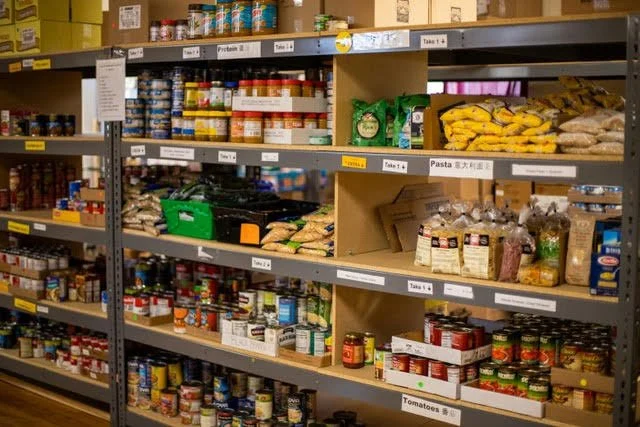
What should your emergency pantry look like?
The last thing people probably think about in an emergency situation is consuming the proper quantities and varieties of food to meet the daily recommended amounts. The Canned Food Alliance suggests stocking your emergency pantry with a variety of nutrient-rich foods and recommends keeping the following amounts of food and water per person per day.
beans & meat
Canned meat, chicken, turkey, seafood and other protein-rich foods such as beans, nuts and nut butters. Should be enough for 5.5 ounces per person/day.
Options (per person/day).
1 5 oz can meat, fish, chicken, turkey
1 15 oz can beans
keep nut butters and nuts on hand. 1 Tbls peanut butter or 1/2 oz nuts is equivalent to 1 oz meat.
vegetables
Canned vegetables and canned vegetable juices - should be enough to provide about 2.5 cups/day.
fruits
Canned fruits and fruit juices - enough to provide about 2 cups/day. Keep dried fruit on hand: 1/4 cup dried fruit = about 1/2 cup canned fruit.
grains
Ready to eat cereal, crackers, pretzels, instant oatmeal or other non-perishable grain products (granola, granola bars) that don’t require cooking. Should be enough to provide 6 oz of grain equivalent per day. 1 ounce = 1 cup ready-to-eat cereal or 5 whole-wheat crackers.
water
Enough for at least 1 gallon per day per person.
Note: in hot weather or when vigorous activity is required (such as disaster clean-up), people perspire more and may need to plan to have additional fluids.
miscellaneous
Nice to have on hand: other non-perishable items such as canned chili, soup, spaghetti, trail mix, instant pudding, salt, pepper, other condiments, cookies, candy. Plan for food and water for infants, those with special health needs and don’t forget your pets.
Food resilience
Tips for basic emergency food storage
An emergency on an island such as ours presents difficulties that, though similar to an emergency on the mainland, can be more immediate and intense. One of those is the faster depletion of grocery store stock and the difficulty in re-stocking if transportation is disrupted. It is important that all households store food for such an emergency. It is one of the simplest and most important preparedness activities your family can do.
Begin Small. Plan to store enough food and water for your family for 3 days. As you feel able, extend the storage to cover two weeks.
The recommended amount of water to store is 1 gallon per person per day. About half of this amount is for cooking and drinking; the other is for personal hygiene. Remember to include 1 gallon/day for each animal you have.
Store your emergency food away from your kitchen. This helps decrease the likelihood that you will use the food in a non-emergency without replacing it. You might consider storing it away from your house in moisture-proof and animal-proof containers. If this is not possible, consider your garage or shed. Remember to stockpile food for pets!
Choose food that:
a. Has a long shelf-life.
b. You and your family like and usually eat. This makes rotating your food storage according to expiration dates much easier for you, because you will be able to use the food that is close to expiration.
c. Is easy to prepare (could be eaten at room temperature or heated in a pot using a portable gas stove or “rocket stove”, barbecue, etc.)* Some pouches that are intended for use in a microwave also have directions for heating on a stove.
Mark each food item with the expiration date. Once or twice a year, move food that is close to expiration to your kitchen to use or donate to food bank (they can often use it after expiration.). Replace it with new food for storage, remembering to date it for expiration.
Portable butane gas burner stoves, small gas cartridges, and rocket stoves are available online or at camping stores, etc.
*NOTE: portable gas stoves, rocket stoves and barbecues should NOT be used indoors.
Food resilience working group
This team aims to enhance our island’s food security. Working with existing strategic community partnerships, we promote a strong and sustainable food network to include growing, preserving, storing, and distribution, thus reinforcing local self-sufficiency and resilience.
If you would like to join this group, please send an email to southwhidbeyprepares@whidbey.com