
How to get prepared: Radio communications
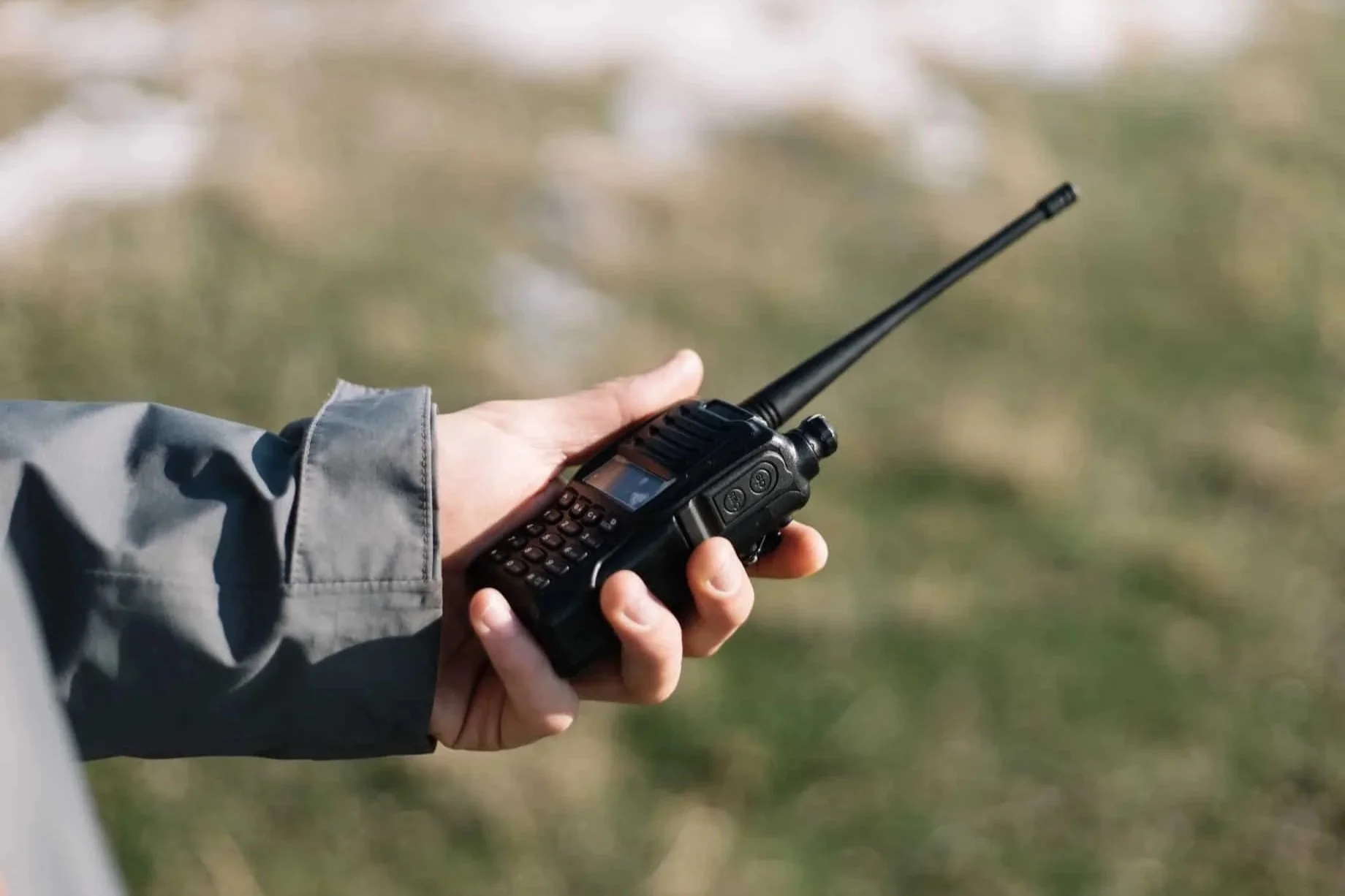
Use of radios in neighborhood emergency response
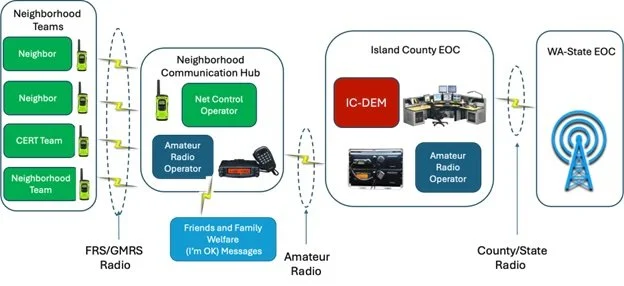
Radios of various types can be a useful tool to help coordinate a neighborhood’s response to a disaster. FRS radios (walkie-talkies) are inexpensive and allow neighbors to communicate with each other over short ranges. Hand-held GMRS radios are slightly more expensive but allow communication over longer distances. Amateur radios (such as ham radios) allow a neighborhood to communicate over very long distances and, for example, exchange information with the Island County Emergency Operations Center (EOC), communicate with distant neighborhoods, or send status reports to friends or relatives in other states.
Here's what it looks like when all the pieces are in place:
-
These recommendations are based on the radio team’s research.
The main differences among radios are their range, their complexity, and their cost.
FRS radios communicate across short distances (a couple of miles at most, depending on terrain). They are the least expensive and need no license.
GMRS radios have a greater range and are more complex to operate than FRS radios. They also require a no-test license to operate.
Ham radios have the greatest range and the most complex operations. Licensing requires passing exams on radio regulations and theory.
-
FRS Radio
Low powered Family Radio Service
Inexpensive hand-held “walkie-talkies”
22 channels
Requires no license
Easy to use
Allows neighbors to keep in touch with each other over moderate distances (~a couple miles depending on terrain)
You can of course purchase whatever you want. For consistency with other neighborhoods so we can provide mutual aid learning these tools, we recommend the Motorola T470.
-
Higher powered General Mobile Radio Service
Allow communication over longer distances
Good for communications between neighborhoods
Same 22 channels as FRS
Allows use of external antennas
Allows use of “repeaters”
License required (no test; $35 fee; apply online)
You may of course purchase whatever you like. For consistency with other neighborhoods so we can support each other’s learning curve, we recommend the Btech GMRS-V2 or Motorola T470 FRS handheld radios.
-
Amateur radios (such as “ham” radios)
Allow communication over very long distances—to the County Emergency Operations Center or out of the area, such as to relay “I’m ok” messages for families
Hand held and mobile configurations are available
FCC license required (2-day class, online study sites)
Join the South Whidbey Prepares Radio Registry
SWP would like to map the locations of FRS and GMRS operators. The information will be used to develop a radio network connecting SWP neighborhoods and to assist in connecting neighborhood radio operators with Ham operators who can relay information from neighborhoods to the County Emergency Operation Center. Note that the location information provided will not be shared outside SWP. If you would like to be included on the map of radio operators, please complete this form.
Additional information
A Beginners GMRS Radio Course: BTECH GMRS-V2 radios will get you started using your radio.
A quick reference guide to the BTech GMRS-V2 radio
A suggested channel list for GMRS radios
How to Get a GMRS License—Online Application Process provides detailed instructions for obtaining a GMRS license. If you receive error messages or get misdirected on the FCC website, FCC advises clearing your browser cache and history in your browser’s settings and trying again.
The booklet Use of Radios in Responding to Neighborhood Emergencies describes how to choose appropriate radios, how to use those radios, and how to integrate a number of radio operators into an efficient network that can coordinate radio traffic within a neighborhood as well as communicate with other operators outside the neighborhood.
Island County Auxiliary Communication Service (ICACS) is a group of ham radio operators involved with emergency communication in Island County. The Neighborhood Support Group within ICACS stands ready to assist neighborhoods with all issues related to radio use. This can include assistance in selecting appropriate radios, programming those radios, “mapping” a neighborhood to determine how best to ensure all neighbors can communicate with each other, etc. Read more: ICACS Emergency Communications Support/Services for Neighborhoods within Island County.
The ICACS Neighborhood Communications Development Plan flyer gives you top-level information from getting organized before you purchase, to purchasing and getting the communications set up from local to integrated.
The ICACS Radio Selection Document Trifold is a great reference to help you know which radio will work best for you and your neighborhood. It is set up as a trifold flyer, front and back. Champions, feel free to print copies for your neighbors.
Contact us with questions or for more information.
Learn more

Do you have helpful information to add? Or perhaps a question you’d like to pose to this community? Use the comment box below.